

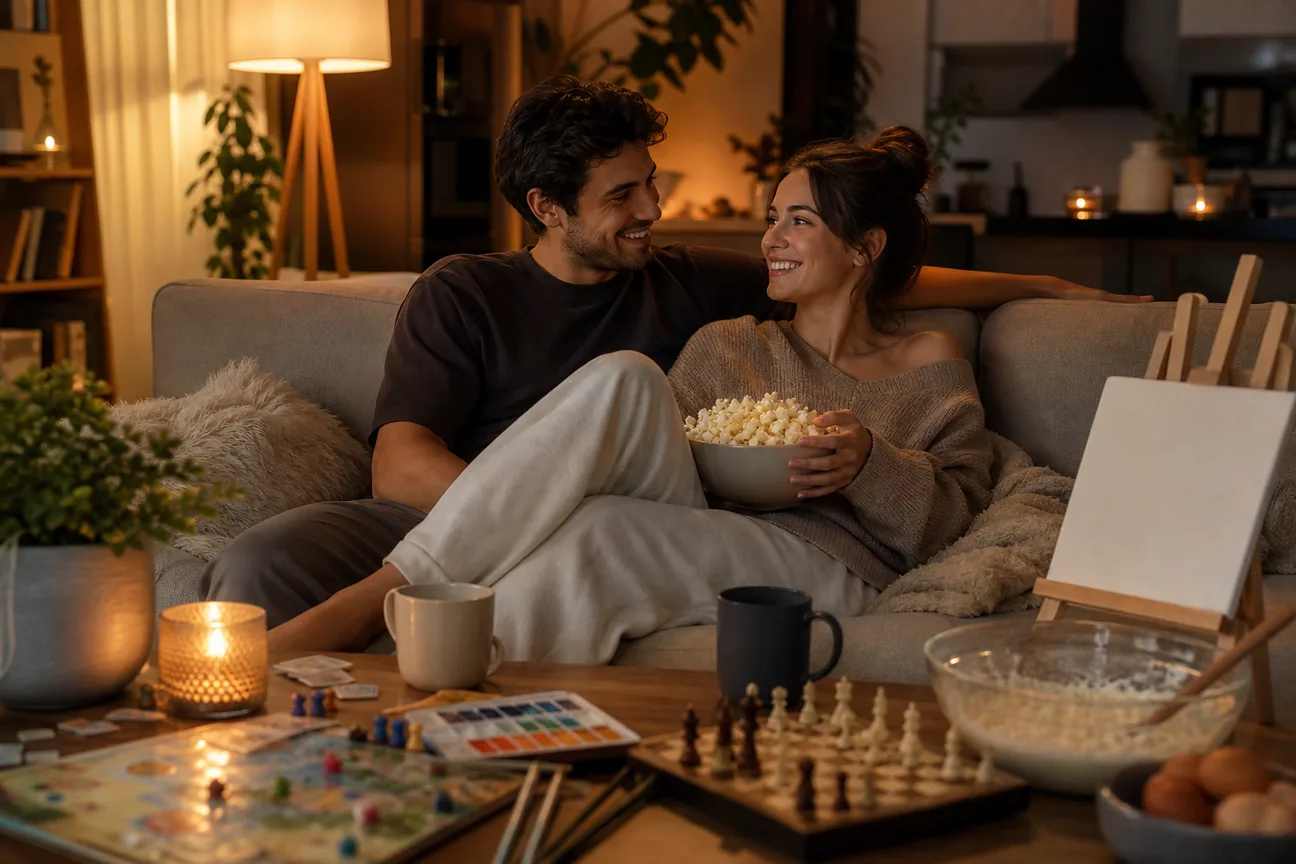
Most couple activity lists give you "go to dinner" dressed up 75 different ways. These eight are different. They're specific, tonight-sized, and actually fun , whether you've got an hour or the whole evening, and whether the couch is calling or you're ready to move.
Table of Contents
- 1. BlushQuest — A Couple Quest That Feels Like a Game, Not Homework
- 2. Cook a Real Meal Together — With Wine and No Shortcuts
- 3. Blind Tasting Night — Wine, Whiskey, or Tea
- 4. Canvas Painting with YouTube and Wine — No Talent Required
- 5. Learn a Dance Style Together via YouTube
- 6. Indoor Picnic on the Floor — Better Than the Couch
- 7. Trail Walk with Coffee or Wine — Thirty Minutes That Resets Everything
- 8. Blanket Movie Night — Done Right, Not Just Default
- Quick-Pick Guide: Which Activity Fits Tonight?
- FAQ
- Conclusion
1. BlushQuest — A Couple Quest That Feels Like a Game, Not Homework
BlushQuest is a quest-style relationship app built for couples who still love each other but have quietly drifted into logistics mode. Two phones, one couch, and date night that has somehow become dinner plus another episode. Sound familiar?
Here's how it works. One partner builds a quest of 7 or 15 wish cards, written themselves or chosen from 300+ options across six categories: Affection & Romance, Flirting & Anticipation, Playful Intimacy, Sensory Touch, Care & Support, and Shared Experiences. They invite their partner, who accepts and writes cards back. Both play in parallel, one active card each.
A card opens. You complete it inside its 2- or 4-day window. Your partner rates it. The next opens. On-time completions build a streak. When all cards are done, one of you is crowned Quest Champion and your couple level goes up.
What makes it different from every other couples app is the scoreboard. Other apps hand you homework. BlushQuest gives you a streak, a champion, and a couple level to climb. The cards are personal because your partner wrote them, not an algorithm. And only the sender pays , your partner never hits a paywall. That's the strongest thing about the pricing model: one subscription covers both of you.
The subscription runs $118.99 a year (that's $4.96 each per month on the yearly plan), $83.90 for six months, or $16.90 month-to-month. There's a 14-day free trial on the yearly plan. You need nothing except a smartphone.
It's best for couples three to fifteen years in who feel more like flatmates than partners and want to do something about it without starting A Conversation. If you're the one who noticed the drift first, this is for you. Shared novel activities and rituals with symbolic meaning are consistently linked to higher relationship satisfaction , which is exactly the mechanic BlushQuest is built on.
The one caveat: you need to actually send the quest. If neither partner presses start, you're back on the couch. The nudge has to come from somewhere, and that somewhere is usually you.
2. Cook a Real Meal Together — With Wine and No Shortcuts
Not heating something up. Not ordering in with a candle lit nearby. Actually cooking together, where one person reads the recipe and the other handles the knife, and you switch halfway through because someone is getting bossy about the garlic.
The simplest version: pasta, a gourmet pasta sauce made from scratch, crusty bread, and a bottle of wine. That's it. The magic is in the side-by-side work. Research consistently points to shared daily activities combined with real conversation as drivers of short-term relationship satisfaction, and cooking is exactly that: a shared activity with a built-in conversation loop.
You're not watching each other. You're doing something together. There's a goal (dinner), light competition (whose sauce is better), and a payoff you eat together at the end. That's a full arc in 45 minutes.
Make it feel deliberate rather than default. Put your phones in the other room before you start. Pick a recipe you've never made. Buy one ingredient you've never cooked with. The unfamiliarity is the point , it breaks the routine pattern and gives you something to talk about besides tomorrow's schedule.
If one of you hates cooking, make it easier: let one person be the sous chef (chopping, measuring, pouring wine) while the other calls the shots. You're still collaborating. The debrief over the finished meal is usually better than the cooking itself.
No cost data for this in the research , but a mid-range pasta night with wine runs whatever your grocery store costs. Cheap enough to do on a Tuesday.
3. Blind Tasting Night — Wine, Whiskey, or Tea
Pick three bottles. Cover the labels. Pour into identical glasses. Score each one on a piece of paper without showing your partner. Then reveal.
The format works with three Cabernets, three whiskeys, or three teas if you're not drinking. The actual category matters less than the competition. You will be surprised how quickly two people who live together and barely play anymore get loud and competitive over whether the $12 bottle beat the $40 one.
The scoring keeps it structured. Give each drink a number from 1 to 10 on taste, and write one word for how it smells. Read your scores aloud at the end. Argue about it. This is a couples activity that requires zero planning skill and costs as much as three bottles of whatever you already like.
One honest caveat: if one partner isn't into alcohol, a tea tasting or a chocolate blind tasting works just as well. The mechanic is the same , mystery, scoring, reveal. Keep it silly rather than educational and it stays fun rather than feeling like homework.
Add a small stakes prize if you want to push it further. Whoever scores closest to the actual price ranking picks the next date night activity. Low stakes, but the scoreboard changes the energy.
4. Canvas Painting with YouTube and Wine — No Talent Required
Two cheap canvases, basic acrylic paint from a dollar store or craft shop, and a YouTube tutorial picked at random. That's the whole setup. You don't need to be good at this. Being bad at it is kind of the point.
Pick the same tutorial and try to paint the same thing. Compare your results at the end. One will be better than the other, and whoever it is will be insufferable about it for exactly the right amount of time. Or ignore the competition entirely and just paint whatever you want while the tutorial plays in the background.
The reason this one works is that it takes your hands off your phones for ninety minutes. You're both focused on something, there's light background noise from the tutorial, and wine loosens the self-consciousness that usually stops adults from trying anything creative. YouTube has beginner-friendly paint-along tutorials for every skill level , search "beginner acrylic painting tutorial couple" and you'll find dozens with clear step-by-step instructions.
If you want to go further: paint each other's portrait. Not the tutorial, just your partner's face from life. It takes twenty minutes and produces something genuinely hilarious. Put them on the fridge.
The only thing to sort beforehand is the paint and canvases , grab them the same day. Everything else is already in your home.
5. Learn a Dance Style Together via YouTube
Pull up a beginner salsa tutorial, clear a space in the living room, and commit to it for thirty minutes. Any style works , salsa, bachata, two-step, even a basic waltz. The category doesn't matter. The rule is both of you try.
Dancing together is one of those activities that forces physical closeness in a way that doesn't feel forced. You have to hold each other. You have to communicate when you're stepping on feet. You'll laugh. And laughing together while being slightly bad at something shared is one of the fastest ways to feel close again after a week of logistics and parallel scrolling.
The format is simple: find a beginner tutorial (fifteen to twenty minutes long), watch the first section together, then try to copy it. Pause often. Don't rush. If one of you gets it faster, teach the other. That role reversal , whoever is usually the "capable one" needing to be guided , is often the most fun part.
Commit to one style for at least two tries before giving up. The first run is always awkward. The second run is when it starts to feel like something. If you both love it, find an in-person class. That becomes a recurring couples activity with a reason to dress up and get out of the house.
Cost: zero. You need a cleared floor and a YouTube search. If you want the best apps for couples that add structure and anticipation to nights like this, that guide covers the full landscape of options alongside BlushQuest.
6. Indoor Picnic on the Floor — Better Than the Couch
Lay a blanket on the floor. Light a few candles. Put out finger food , cheese, crackers, fruit, whatever's in the fridge. Sit on the floor and eat it together with no table, no TV on in the background, and no phones face-up.
This sounds almost too simple. It works because of one thing: the floor changes the room. You're not in your usual spots. The candles change the light. The absence of a table removes the default posture of two people eating dinner. It feels like a deliberate choice, not a default evening.
You don't need to spend money for a date to feel romantic. Intentional time, phones away, actual attention on each other: that's the whole formula. The blanket and candles just signal to both of you that this is different from a Tuesday.
Build it up a little if you want to. Make a playlist before you start. Pick a theme , food from a country you want to visit someday, or a spread of things you ate on your first trip together. The food itself is secondary. The ritual of setting it up together is what shifts the mood.
If you have kids at home and can only do this after they're in bed, this is the easiest option on the list to pull off at 9pm with what's already in the house. No prep, no delivery wait, no leaving the house.
7. Trail Walk with Coffee or Wine — Thirty Minutes That Resets Everything
Get outside. That's the whole instruction. Take coffee and pastries in the morning, or wine and cheese in the evening, and walk somewhere with trees or water. Not a lap around the block , somewhere that actually feels like a destination.
The side-by-side format of walking does something that sitting across a dinner table doesn't. The pressure to make eye contact drops. Conversation comes easier because you're both looking forward, not at each other. Things get said on a walk that don't get said on the couch.
Thirty minutes is enough. You don't need a full hiking trail. A park, a riverbank, a quiet neighborhood street you've never walked before , any of these work. The point is the movement and the no-agenda time. No phones, no podcasts playing, no problem-solving about the week. Just walking and whatever comes up.
If you go in the evening: bring a small cheese board in a backpack, find a bench, and treat it like an outdoor version of the indoor picnic. Same energy, different setting. The fresh air and the slight novelty of being outside your usual loop do a lot of the heavy lifting.
This is the lowest-barrier option on the list for couples with kids , you can do it while a neighbor watches the kids for an hour, or after school drop-off before work. It requires nothing but the decision to go.
8. Blanket Movie Night — Done Right, Not Just Default
There's a difference between watching TV together and actually having a movie night. The difference is intentionality. Default is landing on Netflix at 9pm and scrolling for twenty minutes before picking something fine. Done right, a movie night feels like an event.
Start with the setup. Cushions on the floor or a full blanket-nest on the sofa. Specific snacks chosen for tonight, not grabbed from the pantry. A movie picked before you sit down , not scrolled to. Better sound if you have a Bluetooth speaker. Phones face-down from the opening credits.
Then: pick a real theme. A director you both love, back to back. A country you want to visit, followed by food from that country. A decade night where you dress the era and play music from it before the film starts. The theme creates a frame for the evening and turns passive watching into something you both chose together.
The conversation after the credits is often better than the film. A few questions to have ready: What would you have done in their position? Which character reminded you of someone we know? Would you have watched this ten years ago? These aren't deep relationship questions , they're easy, low-pressure, and they keep the night going past the runtime.
Make it a regular thing. Pick a night every week or every other week, take turns choosing the film, and keep a shared list. The ritual matters more than any individual movie. When it becomes yours , your night, your blanket setup, your list , it's worth protecting.
Quick-Pick Guide: Which Activity Fits Tonight?
Not every night calls for the same energy. Use this to find what fits where you are right now.
Activity | Energy needed | Prep required | Best for | Works long-distance? |
|---|---|---|---|---|
BlushQuest | Low | Download the app | Recurring intimacy, not just one night | Yes |
Cook a meal together | Medium | Grocery run | Couples who want to collaborate | No |
Blind tasting night | Low | Three bottles, same day | Competitive, laugh-out-loud energy | Possible (video call) |
Canvas painting | Low–Medium | Canvases and paint | Creative couples, phone-free time | No |
Dance tutorial | Medium–High | Clear floor space | Physical connection, laughter | No |
Indoor picnic | Very low | Blanket, candles, fridge food | Tired couples, late evenings | No |
Trail walk | Low | Shoes and a destination | Couples needing air and real conversation | No |
Blanket movie night | Very low | Film chosen in advance | Winding down, ritual-building | Possible (sync app) |
One honest note on the table above: most of the one-off options here require you to source the supplies yourself and guess the time needed. BlushQuest is the only option that tells you exactly what happens next, when, and what your partner wrote for you. That structure removes the guesswork that free ideas leave behind.
FAQ
What are good activities to do as a couple at home tonight?
The best at-home couple activities are the ones with a clear format and low prep. An indoor picnic on the floor with candles and finger food, a blind tasting with three bottles of wine or tea, or a canvas painting session with a YouTube tutorial all work well on short notice. If you want something repeatable rather than one-off, BlushQuest runs on your phone and gives you a new card from your partner every two to four days.
What do couples do when they run out of things to do together?
Usually the problem isn't ideas , it's energy and inertia. The best move is picking one small thing with a clear start and finish, not planning an elaborate evening. A thirty-minute walk with coffee, a ten-minute blind tasting setup, or opening the BlushQuest app and sending your first quest all take less than five minutes to begin. The hardest part is starting, not the activity itself.
How do couples reconnect when they feel like roommates?
Shared novel activities and rituals with meaning are the most consistent drivers of reconnection, but they don't need to be dramatic. Side-by-side tasks like cooking, dancing, or painting work because they put you both in motion toward the same goal rather than consuming the same content in parallel. BlushQuest adds a personal layer: cards written by your partner rather than generic prompts, which makes even a simple activity feel like it came from them specifically.
What couples activities work for long-distance relationships?
BlushQuest is built for long-distance couples and works entirely on your phones. Beyond that, a synchronized movie night using a watch-party app, a blind tasting done over video call (you each buy the same three bottles), or a virtual cooking date where you cook the same recipe on camera are all solid options. The key is shared focus on one thing rather than just talking on a call.
How much does BlushQuest cost?
BlushQuest costs $118.99 a year (around $4.96 each per month on the yearly plan), $83.90 for six months, or $16.90 per month on the monthly plan. Only the partner who sends the quest pays , the partner who receives it never hits a paywall. There's a 14-day free trial on the yearly plan. You need nothing except a smartphone and internet connection.
What couple activities don't require leaving the house?
Every option on this list except the trail walk works at home. The easiest zero-prep picks are the indoor picnic (blanket, candles, fridge food) and the blanket movie night done with intention rather than by default. For something more interactive, the blind tasting and canvas painting both work in a kitchen or living room and need only same-day supplies from a grocery or craft store.
Conclusion
Tonight, instead of Netflix by default: pick one thing from this list and just start it. The trail walk takes only your shoes. The blind tasting takes three bottles. The canvas painting takes a trip to a dollar store. And if you want something that gives you a personal card from your partner every few days and a scoreboard to climb together, try BlushQuest free for 14 days.