


Best Apps for Couples in 2026
There's an app for tracking your sleep, your calories, and your commute. So why not your relationship? The couples app space has matured fast, and right now there are genuinely good options for every type of partnership. Here are eleven of the best apps for couples, what each one actually does, and who it's really for.
Table of Contents
- 1. BlushQuest — Gamified Wish Cards That Both Partners Actually Play
- 2. Paired — Daily Rituals Built Around Expert-Backed Prompts
- 3. Gottman Card Decks — Free Research-Backed Conversation Starters
- 4. Lovify — 800+ Conversation Prompts for Couples Who Love to Talk
- 5. Agapé — Simultaneous Reveal Prompts With a Fun Twist
- 6. Lovewick — Points and Achievements for Budget-Conscious Couples
- 7. Ember — Habit Streaks and Daily Couple Competitions
- 8. Cupla — Shared Scheduling for Long-Distance Couples Across Time Zones
- 9. Flamme — AI Coaching for New Long-Distance Relationships
- 10. The And — Deep Questions for Emotionally Secure Partners
- 11. Kindred — Weekly Check-Ins With Built-In Follow-Through
- How to Pick the Right App for Your Relationship
- FAQ
- Conclusion
1. BlushQuest — Gamified Wish Cards That Both Partners Actually Play
BlushQuest is a quest-style relationship app where one partner builds a deck of wish cards from 300+ curated activities across six categories, and the other races to complete them against a countdown. Earn badges, level up, and compete for the Quest Champion crown. It's built for couples who want to do things together, not just talk about them.
What makes BlushQuest different from almost everything else on this list is the subscription model. One subscription covers both partners. Only the sender pays, so your partner never hits a paywall mid-quest. That's a genuine rarity in this category. Most competitors charge each person separately or lock the second partner behind a paid wall after the free trial ends.
BlushQuest runs a 14-day free trial on the yearly plan. That plan is $118.99 a year, which works out at about $4.96 a month each once you split it between the two of you. It is not the cheapest option on this list — per person, Paired and Coral both come in lower. What you are paying for is the quest format and the fact that your partner never needs a subscription of their own.
The one caveat: BlushQuest launched in 2026, so it doesn't have years of user reviews to point to. But the mechanics are solid, and if you want a couples app with actual gameplay, not just questions, this is your first stop.
Try BlushQuest free for 14 days →
2. Paired — Daily Rituals Built Around Expert-Backed Prompts
Paired is the most established name in this category. It runs a daily question, quiz, or relationship exercise developed with licensed therapists and researchers. The content is genuinely expert-led, which gives it real credibility.
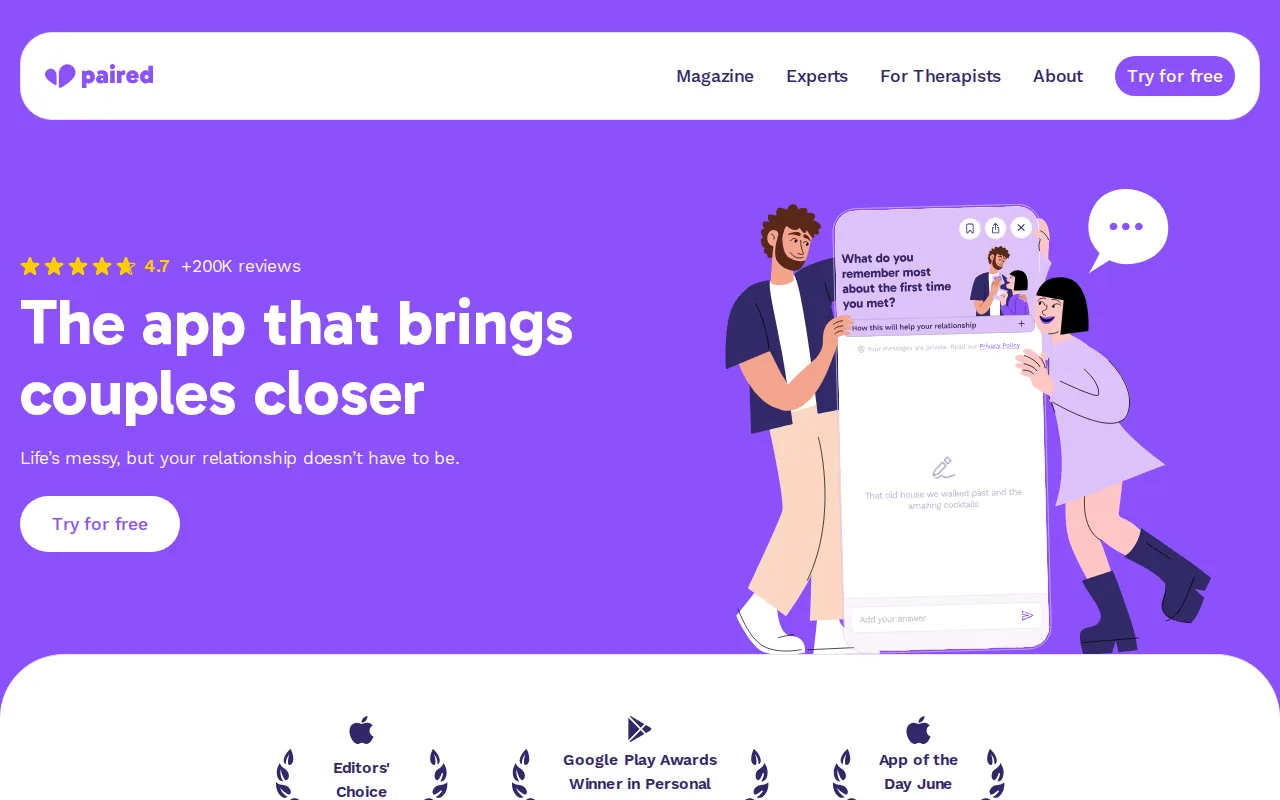
The app has a large library of expert-led quizzes and a free tier with limited content. The daily cadence works well for couples who want a quick, low-friction touchpoint every morning. Where it falls short is depth: once you've answered the day's prompt, there's nowhere to go. No quest, no follow-through mechanic, no reason to open it again until tomorrow.
Pricing sits around $74.99/year or $14.99/month for one subscription per couple. That's among the higher end of this list. Good app. But if you want more than a daily check-in, pair it with something that has a gameplay loop.
3. Gottman Card Decks — Free Research-Backed Conversation Starters
The Gottman Card Decks app is digital flashcards built by the Gottman Institute, whose relationship research spans more than four decades. Categories include open-ended questions, love maps, and rituals of connection.
It's completely free. That's the strongest argument for it. The questions are excellent, grounded in real research, and cover territory that lighter apps avoid. The limitation is just as clear: it's a content library, not a system. There's no scheduling, no reveal mechanic, no follow-through, and no reason for both partners to open the app at the same time. Think of it as a very good deck of cards, digitized. Useful as a supplement. Thin as a standalone habit.
4. Lovify — 800+ Conversation Prompts for Couples Who Love to Talk
Lovify has one of the biggest question banks in the category: 800+ prompts across ten topics including travel, romance, films, and intimacy. If your goal is sheer breadth, this covers more ground than almost anything else.
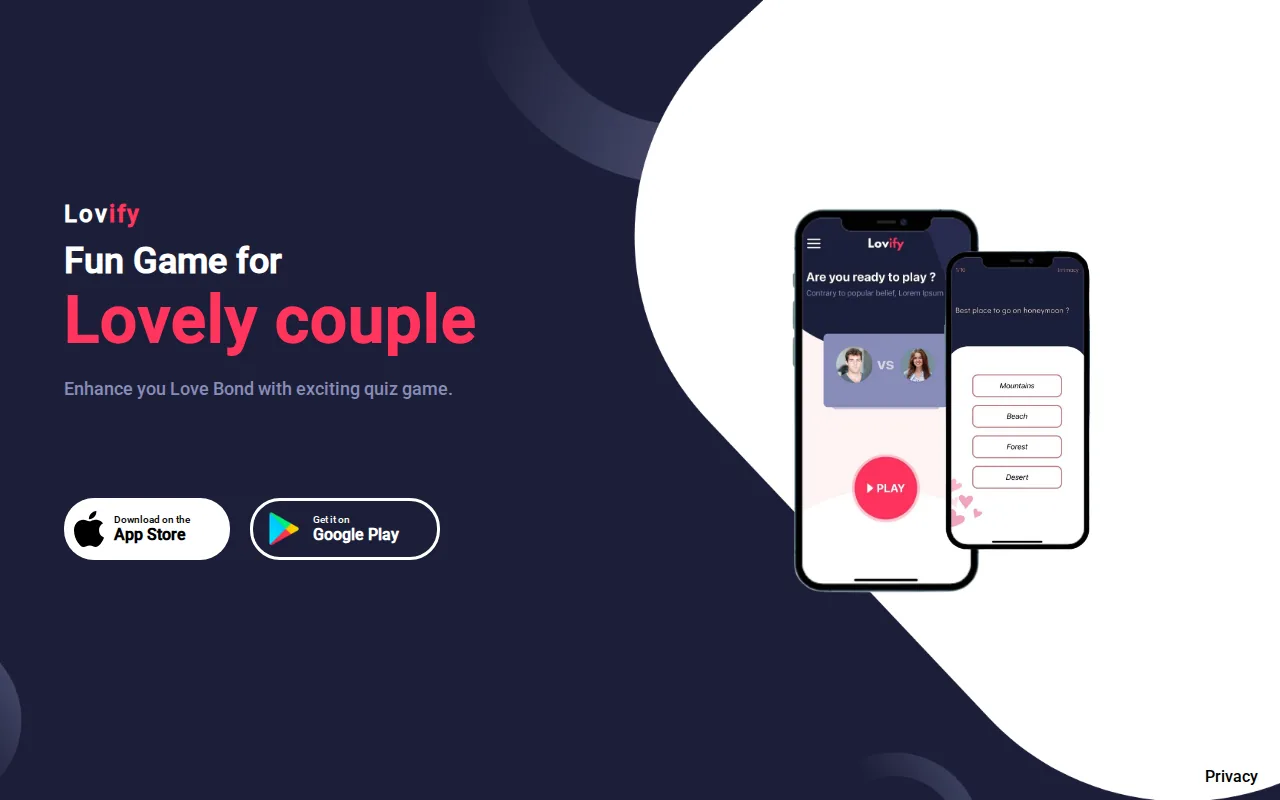
The gameplay has two rounds. In the first, you answer questions about yourself. In the second, you guess your partner's answers. It's a light competitive format that works well for couples who enjoy verbal sparring. Available on both iOS and Android.
The weakness is the same as most card-deck apps: the experience is passive. One person reads, the other answers, repeat. There's no shared board, no escalating stakes, no reason to come back once you've burned through a category. Fun for a road trip. Less sticky as a weekly habit.
5. Agapé — Simultaneous Reveal Prompts With a Fun Twist
Agapé sends both partners the same prompt each day. You answer separately, then both answers appear at the same time. That reveal moment, the split-second before you see what your partner wrote, is genuinely engaging. It's the mechanic that made Agapé popular on TikTok, where couples filmed their reactions.
The app uses a machine-learning algorithm to personalize questions over time, with optional spicy content if you opt in.
Pricing is around $29.99/year per couple or $199.99 for a lifetime option. Fair value. The gap is the same one Paired has: you see each other's answers, and then what? There's no built-in next step, no commitment, no follow-through mechanic. Great reveal. Thin follow-up.
6. Lovewick — Points and Achievements for Budget-Conscious Couples
Lovewick is light, affordable, and built around daily questions, date ideas, and a relationship tracker dashboard. You can set how often prompts arrive, daily or as infrequently as every other week. That flexibility makes it one of the better options for couples who aren't sure they'll actually stick with an app.
The gamification layer includes points and achievements. If that motivates you, great. If earning relationship points feels a little patronizing, it's hard to ignore. The questions lean toward the lighter end of the spectrum. Fun to answer, but less likely to surface something real. The annual subscription is around $29.99, which makes it one of the more accessible picks on this list for couples testing the water.
Worth noting: Lovewick recently reduced its free tier from multiple questions per day to just one. Some long-term users felt that was a meaningful change. If you want the full question bank, the paid tier is where it lives.
7. Ember — Habit Streaks and Daily Couple Competitions
Ember is built around daily habit building with a partner competition angle. You set shared habits, track streaks, and compete against each other for daily wins. It's the most fitness-tracker-adjacent app on this list, which is either its strength or its limitation depending on how you feel about leaderboards in a relationship context.
It works best for couples who already like accountability structures, people who use habit apps solo and want to bring their partner into the loop. The competitive layer keeps it from feeling like homework. The risk is that shared visibility can backfire when one partner falls behind. A broken streak next to your partner's perfect run is a different experience than a private miss. Use Ember when you genuinely both want the competition, not when one of you is trying to bring the other along.
8. Cupla — Shared Scheduling for Long-Distance Couples Across Time Zones
Cupla solves a specific problem really well: coordinating two different schedules across time zones. The app pulls Google, Apple, Outlook, and other calendars into one unified view, automatically handles time zone conversion, and lets you set a weekly date goal with reminders if you haven't planned time together recently.
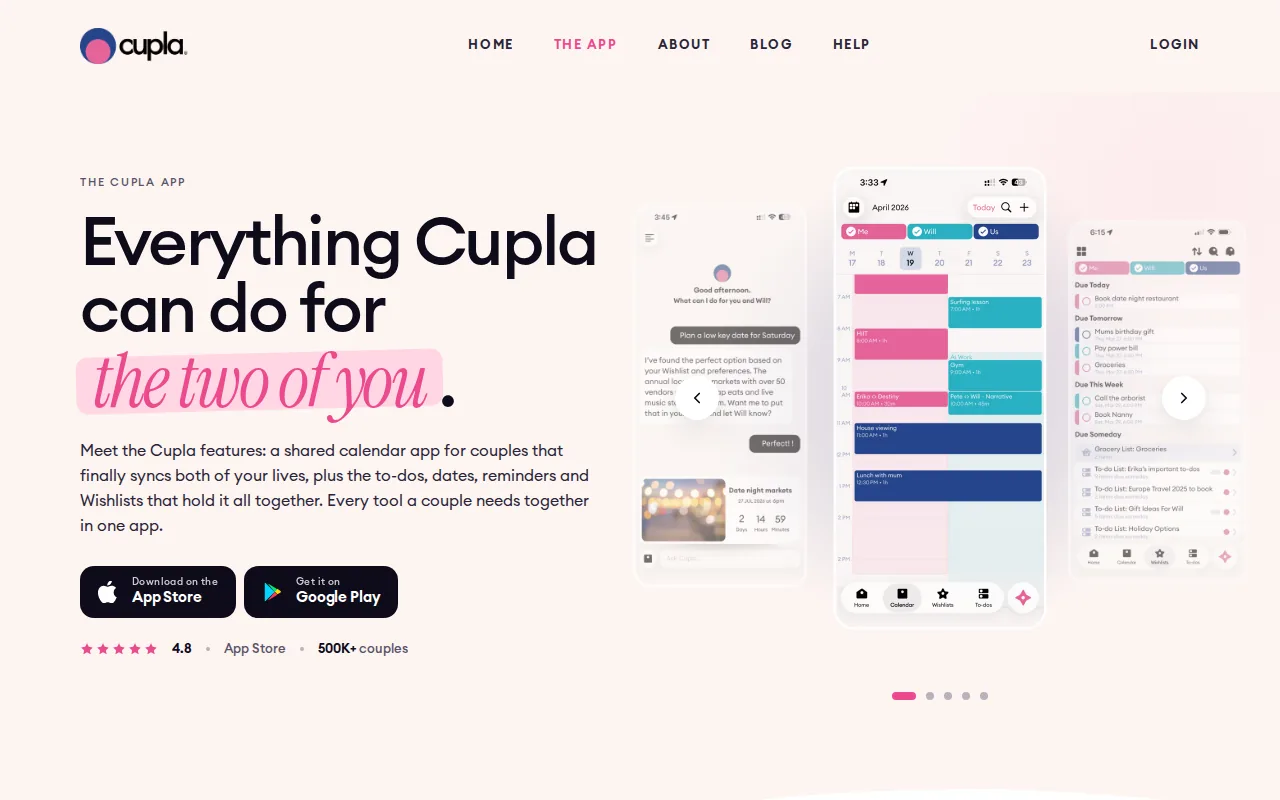
It's designed from the ground up for two people, not adapted from a family organizer or a work calendar. The addition of wishlists, date ideas, and an AI co-pilot to suggest free time slots rounds it out beyond pure logistics.
If your main LDR pain point is coordination, Cupla handles it cleanly. If what you actually need is a shared experience to play together during your video call, this pairs well with something that has a gameplay loop.
9. Flamme — AI Coaching for New Long-Distance Relationships
Flamme uses an AI coach that adapts to your relationship stage. After onboarding, you answer daily discovery questions separately, then both answers unlock at the same time. The AI coach, called Flamme AI, offers advice on date planning, conflict, and intimacy. In 2025 the app released Duo AI for shared sessions and LDR Buddy specifically for long-distance couples.
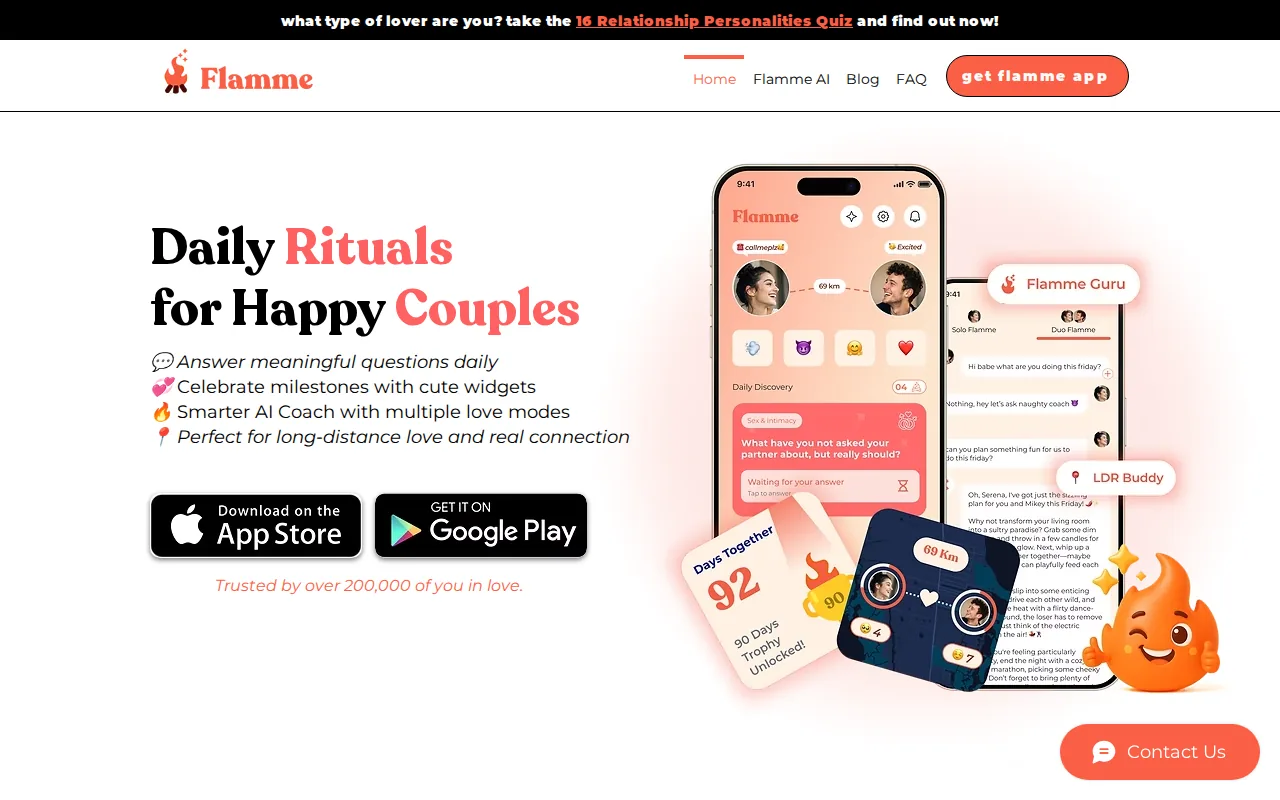
It's one of the more thoughtful options for couples in the early stages of a long-distance relationship who are still building communication patterns. Pricing details are available on the app's listing, and the free version is genuinely usable, not just a teaser.
The honest limit: Flamme works best as a daily ritual tool, not as a game. If you want conversation depth plus an experience you actually play together, it's better as one layer of a broader setup than a standalone solution.
10. The And — Deep Questions for Emotionally Secure Partners
The And is documentary-style. The questions go places most couples apps deliberately avoid. Radical honesty. Hard territory. The kind of prompts that can surface real things if you're both ready to sit with them.
This is not the app to open on a Tuesday when you have 10 minutes before dinner. It's for couples who are emotionally comfortable with intensity, who want to understand each other at a level that lighter apps don't reach. There's no gamification, no streak, no points. Just questions that ask a lot of both of you.
The caveat is real: if either partner isn't in the right headspace, the intensity can land wrong. Best for couples with a strong foundation who want to go deeper, not for couples looking for a fun, low-stakes connection activity.
11. Kindred — Weekly Check-Ins With Built-In Follow-Through
Kindred runs a weekly check-in, not a daily one. Both partners answer the same questions independently, answers reveal at the same time, and then you each set specific commitments for the week ahead. At the next check-in, those commitments come back for review. It's the only app on this list that closes the loop between what you said and what you actually did.
The weekly rhythm means one focused conversation instead of daily pings. Per-couple pricing means one subscription covers both partners. There are no streaks, no badges, no scores. Just the check-in and what you do next.
The limitation is the flip side of the format: a missed week leaves a bigger gap than a missed day in a daily app. And if you want variety, quizzes, or date-night inspiration, Kindred isn't built for that. It does one thing, and it does it seriously.
How to Pick the Right App for Your Relationship
The best couples app is the one both of you actually open. That sounds obvious, but most app abandonment happens not because the app is bad, but because the format doesn't match how the couple naturally operates.
Use this table as a quick filter:
What you're looking for | Best fit | Why |
|---|---|---|
Gamified activities, not just questions | BlushQuest | Quest cards, badges, countdown timers, one sub covers both |
Daily expert-led prompts | Paired or Agapé | Polished daily cadence, reveal mechanic, therapist content |
Free and research-backed | Gottman Card Decks | 40+ years of research, completely free, no account needed |
LDR scheduling across time zones | Cupla | Unified calendar with auto time-zone conversion |
Weekly ritual with accountability | Kindred | Commitments loop, simultaneous reveal, weekly not daily |
AI coaching for new LDR | Flamme | Adapts to relationship stage, LDR Buddy mode |
Budget option with gamification | Lovewick | ~$29.99/year, adjustable frequency, light and low-commitment |
Deep, intense conversation | The And | Documentary-style radical honesty prompts, no fluff |
Habit building with competition | Ember | Daily streaks, partner leaderboard, habit-first design |
One usable rule: if only one of you wants to use the app, the app won't save the habit. Pick something both partners find genuinely interesting, even if it's not the most feature-rich option. A simple app you both open beats a sophisticated one that collects dust.
FAQ
What is the best app for couples who want to do things, not just answer questions?
BlushQuest is the strongest pick here. One partner curates wish cards from 300+ activities; the other completes them on a countdown. You earn badges, level up, and compete for the Quest Champion crown. Most rivals are question-only apps. BlushQuest's quest format makes it feel like a game you play together, not a worksheet you fill out separately. One subscription covers both partners.
Are there free couples apps that are actually worth using?
Yes. The Gottman Card Decks app is completely free and built on 40+ years of relationship research. Lovify also has a free tier with access to its question bank. Lovewick offers one free question per day on its free tier. None of these match the full experience of a paid app, but Gottman Card Decks in particular is worth downloading as a supplement to any paid app you use.
Which couples app is best for long-distance relationships?
Cupla handles scheduling and time zone coordination better than anything else on this list. For daily emotional connection, Flamme's AI coaching adapts to LDR dynamics specifically and has a dedicated LDR Buddy mode. If you want a shared experience to play during a video call, BlushQuest works across any distance since only the sender needs an active subscription.
How do I get my partner to actually use a couples app?
Pick something with immediate payoff rather than long-term promise. Apps that feel like a game on the first session, like BlushQuest, tend to get more buy-in than apps that front-load their value with a long onboarding quiz. Keep the first session short. And choose together rather than presenting it as something one of you decided. The partner who notices the drift rarely gets traction by downloading an app unilaterally.
Is it worth paying for a couples app when free options exist?
Depends what you want from it. Free apps like Gottman Card Decks are excellent for conversation starters but have no structure, scheduling, or follow-through. Paid apps like BlushQuest, Paired, or Kindred give you a consistent format, a reason to come back, and mechanics that make both partners feel like active participants. BlushQuest's yearly plan is $118.99, which is roughly $4.96 a month each once you split it between the two of you, and only one of you ever pays. Whether that's worth it depends on how much you'd actually use it.
Do couples apps actually help relationships?
They help with consistency. Having a dedicated format for connection, whether a daily question or a weekly quest, reduces the friction of "we should talk more" without requiring a serious conversation to start. Apps won't resolve deep conflicts. But used as a regular habit, they create more touchpoints and surface things partners might otherwise miss. Independent evidence on any specific app is limited, but the consistency a structured format provides is where the real value tends to show up.
Conclusion
If you want the simplest possible answer: start with BlushQuest. The quest card format works for couples at any stage, one subscription covers both of you, and the 14-day free trial means you lose nothing by trying. Add Gottman Card Decks for free conversation starters on the side, and you have a solid two-app setup for almost any relationship. Start your free trial and pick your first quest tonight.