


You still love each other. You have just stopped playing.
Most couples who say they feel like roommates are not describing a crisis. They are describing a house that runs well. The bills are paid, the school run happens, somebody remembered the dentist. Two competent adults are managing a shared operation, and somewhere in the managing, the part where you were interested in each other went quiet.
Table of Contents
- What roommate drift actually is
- Why the big talk usually makes it worse
- Start with something to do, not something to discuss
- Five small moves that work this week
- When it is more than drift
- Where BlushQuest fits
- FAQ
What roommate drift actually is
Roommate drift is what happens when every conversation you have is logistics. Not arguments. Logistics. Who is collecting whom, what is for dinner, did the thing get booked.
It creeps because nothing goes wrong. There is no fight to resolve and no moment to point at. You simply notice one Sunday that you have not been alone together without a screen in a week, or you watch your partner laugh at a stranger’s joke and feel something you have not felt in a while.
The clearest sign is not that you argue. It is that you are polite. Couples in the roommate phase are often extremely pleasant to each other, in the way colleagues are pleasant.
This is ordinary, and it is common after a baby, a house move, a demanding stretch at work, or any year where survival took priority. It is not evidence that you chose wrong.
Why the big talk usually makes it worse
The instinct is to sit your partner down and name it. That conversation has a poor record, for a reason that has nothing to do with how much you mean it.
To the person hearing it, “I feel like we are more like roommates” lands as a verdict on them. They were not aware there was a problem, and now there is one, and they are apparently already failing at it. The most common response is defensiveness, and the second most common is a promise that both of you know will not survive a busy week.
It also puts the conversation before the evidence. You are asking someone to agree that something is missing when neither of you has felt it present for months. That is a hard sell on a Tuesday night.
Start with something to do, not something to discuss
The couples who come out of this phase almost never talk their way out first. They do something together, notice that it felt good, and the conversation follows on its own a week later.
This is worth taking literally. Do not open with “can we talk about us.” Open with a walk, a card, a booking, a question asked in the car. The talk is the result, not the method.
The practical version: make one small thing happen this week that neither of you had to negotiate. Then see what you want to say afterwards.
Five small moves that work this week
Each of these is deliberately small. The version of you reading this has had a long week, and anything ambitious will be postponed and then quietly dropped.
Ask one specific question. Not “how was your day.” Something with a real answer: what took up the most space in your head this week? Our list of questions to ask your partner has more, but one is enough.
Protect twenty minutes, not an evening. Between the kids going down and the two of you giving up on the day. No babysitter, no booking, no energy you do not have.
Do something with your hands. Cooking, a puzzle, a walk. Side by side is easier than face to face when you are out of practice, because nobody has to hold eye contact while finding something to say.
Let one of you plan it. Alternate. The person who plans chooses, and the other says yes. This removes the negotiation that kills most plans before they happen.
Say the specific thing you noticed. Not “you are great.” “I saw how you handled that call and it made me want to be better at that.” Specific praise works because it proves you were paying attention, which is the thing that actually went missing.
If you want more of these, our guide to couple bonding activities and our piece on how to reconnect with your partner tonight both go further.
When it is more than drift
Roommate drift is a distance problem, and distance responds to attention. Some things do not.
If what you are feeling includes contempt rather than distance, if either of you is afraid, if there is coercion, or if one of you has already quietly decided and is waiting for a moment, then none of the above is the right tool. That is worth taking to a couples therapist or another qualified professional, and it is not a failure to do so.
The test is roughly this: drift feels like absence. If what you feel is closer to dread, it is a different conversation and it deserves better support than an article.
Where BlushQuest fits
We built BlushQuest for the drift version of this problem, because it is the one nobody makes a product for.
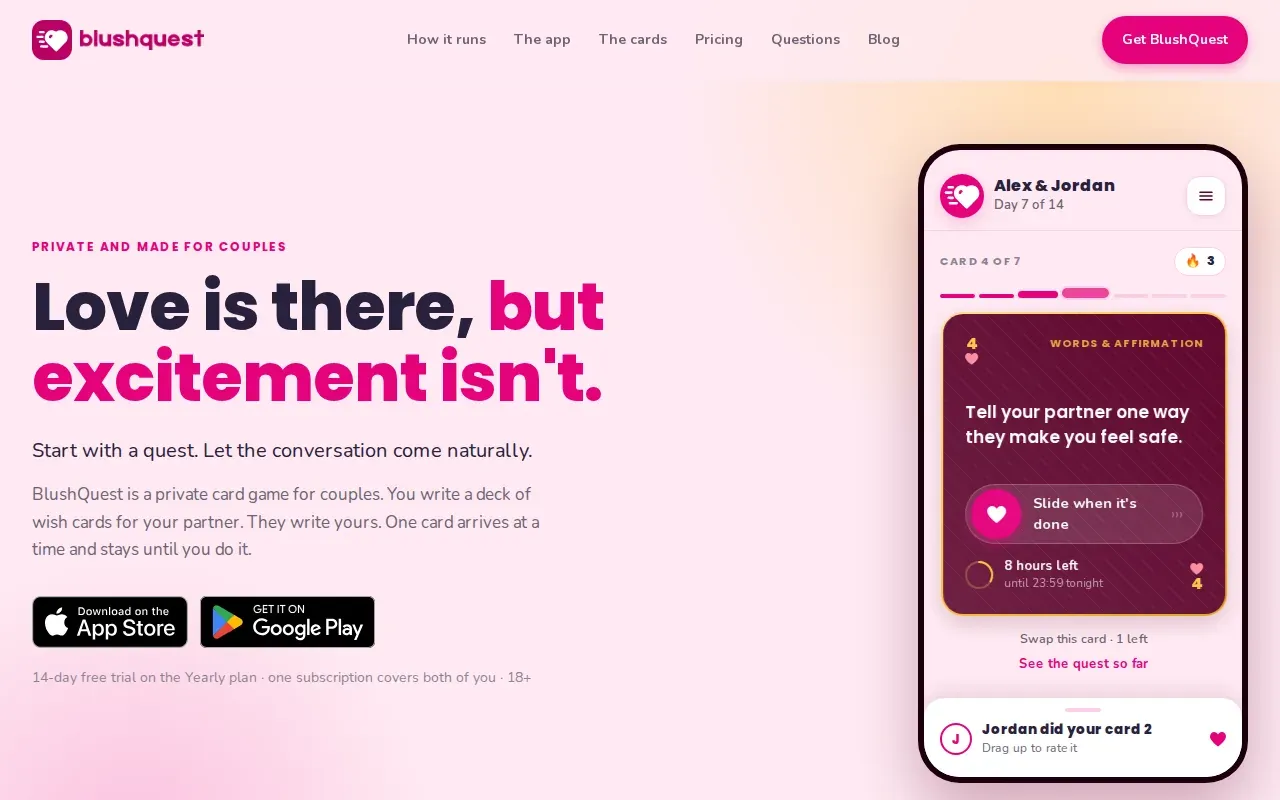
One partner creates a quest of 7 or 15 wish cards, choosing from more than 300 curated ideas or writing their own, and picking which of the six categories are in play. You send an invitation. Your partner decides whether to accept, then writes cards back. The invitation can be a surprise; participation never is.
Then it does the part that usually fails. Cards open one at a time inside a two- or four-day window, so there is always a next thing and it always has a deadline. The partner who wrote a card rates how it went once the other completes it. Finishing on time builds a streak and raises your couple level, and at the end of a quest the ratings, timing and each partner’s final streak decide the Quest Champion.
The reason it fits this particular problem is the direction of the ask. You are not requesting a conversation about the relationship. You are sending your partner something you would like, written by you, that they can accept or decline. It reads as a gift rather than a complaint, which is the difference between the two openings described above.
BlushQuest is for adults 18 and over in committed relationships. It is not therapy, crisis support, or a way to persuade a partner who does not want to play. One subscription covers both partners and only the person sending the invitation needs it; the Yearly plan opens with a 14-day free trial.
FAQ
Is feeling like roommates normal?
Very. It is most common in couples who are competent and busy, particularly in the years after a first child or during a demanding stretch at work. It tends to say more about how full your weeks are than about how you feel about each other.
How long does it take to come out of it?
Usually less time than people expect, and it rarely happens in one evening. What changes things is a few small shared moments close enough together that they start to feel like a pattern rather than an exception.
What if my partner does not think anything is wrong?
That is common, and it is not indifference. Try an action rather than a diagnosis: suggest something specific and easy this week. If it goes well, the conversation gets much easier, because you are then talking about something you both just enjoyed.
What if we have tried before and it did not stick?
Then the problem was probably follow-through rather than willingness. Most couples can name five things they would enjoy doing together and still end the month having done none of them. Pick one, make it smaller than feels worthwhile, and decide the next one before this one ends.
Do we need an app for this?
No. A standing Thursday and one specific question will do most of the work. An app helps with the part people actually lose, which is remembering to keep going after the first good week.
Conclusion
Feeling like roommates is not a sign that something went wrong between you. It is a sign that the household got loud enough to drown out the rest. Pick one small thing this week, keep it small enough to repeat, and let the conversation arrive on its own. If you want the structure handled, start a private quest and make the first card an easy one.